What questions to ask a fortuneteller
What kind of questions can you ask? Here is a series of ideas. Let’s start with four classical questions, and then move on to other types. Basically questions can be divided into areas of concern with love, money, health, and work. But they can also follow more specific themes.
‘Does he love me?’ can turn into a question about resentment, dependability, or about how to cope with a parasitical, unrealistic thought about what’s expected.
Questions about work can also follow the more specific theme of how to create and experience a symmetrical relationship, as in the situation when you extend yourself to making two steps towards fulfilling your duties over and above what’s stipulated in your contract, and you want to see that your boss also makes two steps towards acknowledging your particular effort that goes into it.
Health questions can follow the theme of causality. What if it’s not a physical condition that causes you to shit blood? What if it’s stress? And if that’s the case, what particular area in your life has become so resisting to knowing it, resisting your conscious mind, that you can’t even put your finger on it? As a general rule, what you don’t know, you can’t control, so it’s a problem.
Questions about money can easily follow the theme of mobility, migration, and transition. A good question to pose in this direction is one that helps you realize that it’s not here, where you are right now, that you’ll make more money, but somewhere else. Where is this place, and what must you do to get there? More money is not always about how to ingratiate yourself so you get a raise, but rather about how to eradicate your fear of changing lanes or anxiety about relocating to a new geographical landscape.
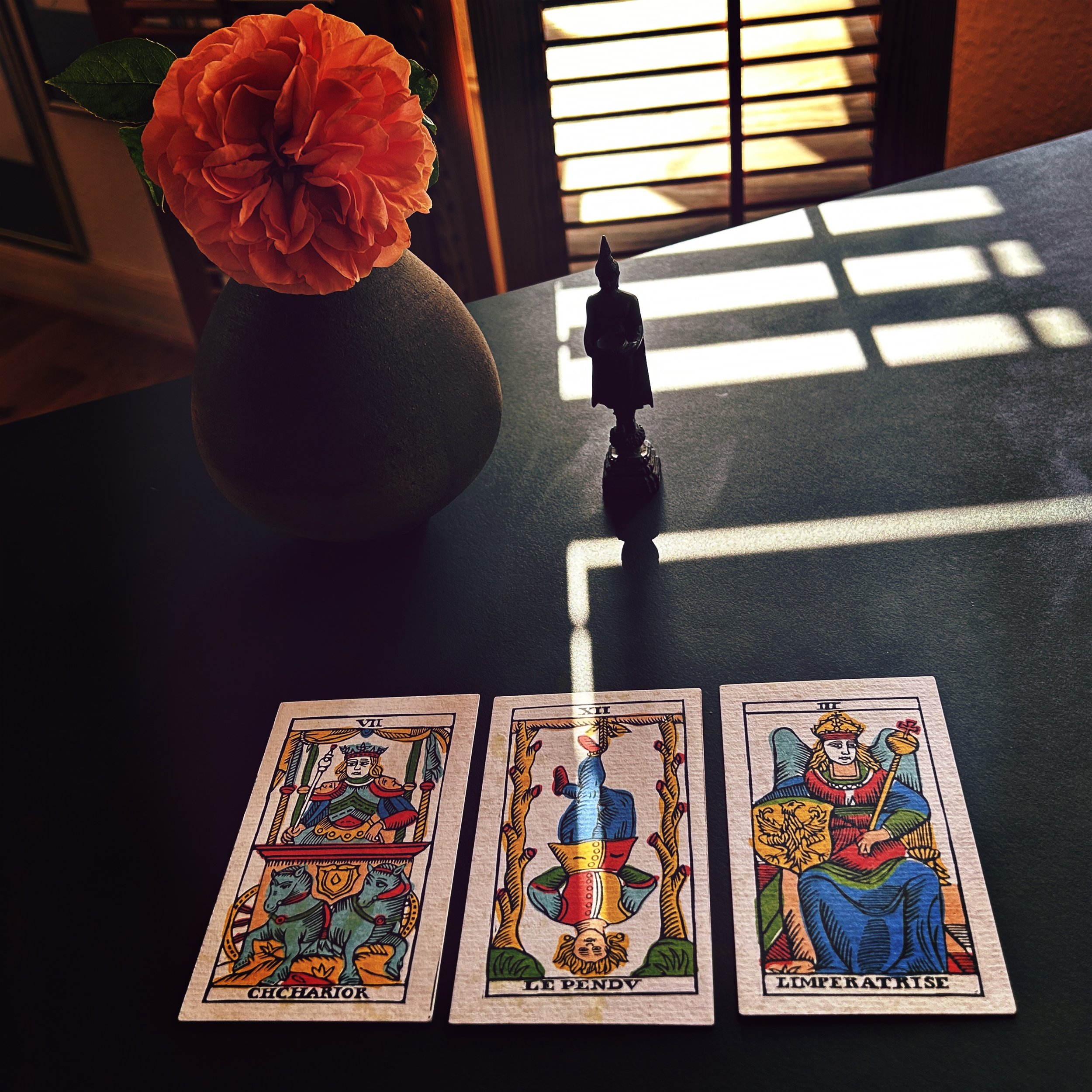
Questions can also be of predictive nature, or of a more metaphysical nature. You can go from: ‘What will I have for breakfast tomorrow?’ to pondering on ‘what’s the meaning of life?’ while you’re also eating cornflakes, a choice that you’ve just divined for yesterday.
Questions can have a descriptive character. Asking a ‘what’ question will give you the sort of insight that describes what is at stake in a situation: ‘what’s the situation here?’ can give you cards that speak to both the situation at hand and its predicament.
Questions can be analytical. Asking a ‘how’ question will give you insight into the necessary steps you can take towards solving a problem: ‘How will I cope with no income next month?’ can point concretely to what is a good idea to perform in order to remedy the situation.
Questions can be of reflective nature. Asking a ‘why’ question will give you access to depth and understanding. ‘Why did he leave me?’ can make you reflect on what went wrong, and then comprehend why you’re feeling the way you do.
Tangible and intangible questions. Generally, you can also ask questions that combine the field of emotion with a practical level. Faith in getting a job is intangible. A question about the actual motion towards getting the job as it relates to your confidence in your skills is tangible. You can use deduction to connect both visible and invisible dots or to create connection to others. You can use questions to strengthen your trust in others or to strengthen your faith in your own clear judgment, perhaps even about the value of self-reliance, in which case trust in others becomes redundant.
You can use a question whose purpose is to transmit knowledge to yourself about a situation that you’re unsure of. By formulating a coherent question related to a context that resists you, or you’re unsure of, you participate invariably in making clearer what is vague in your head.
Questions have a coping or a strategic character, most of the time, as we often want to know something about the modality of doing things. So we ask: ‘how do I do this, concretely?’ But it can also pay off to pose some questions that have an investigative nature, when we want to probe into the underlying premise and structure of what ‘this’ is to begin with.
‘How do I put up with my imbecile boss?’ is a question that presupposes clear knowledge of and insight into another person’s motivations, actions, and psychological mindset. This can now lead to this question, too: are you sure that, when you deem your boss an imbecile, this is also the case? What if the boss’s imbecility is directly a manifestation of the way in which you are acting on the job?
Questions are encounters with the unknown. Asking questions is easy. Asking the right questions is hard. Then there are the questions that arise from the encounter with the fortuneteller, with the beauty of her words, inspiration, and sincerity – not to mention her ability to also answer this question: ‘will I meet the Devil at the crossroads, if I went there on a dark and stormy night…?
Meanwhile, ‘I’d like to know about my boss…’
Here’s an example with the cards for two angles on the boss: ‘I’d like to know about my boss… he is an idiot and we can’t work together, help…’ I’d call this a classic situation for the fortuneteller, who is called upon to impart her impartial wisdom about the blind spots at stake.
But the inverse of the situation can also occur: ‘Help, my boss is an excellently competent person and there’s both mutual recognition and appreciation of what we each do. And yet we clash. There’s some resistance somewhere that I can’t comprehend. What do I do?’
I look at two cards: Temperance and the Star. You’d think that these are good cards calling me to recite, as if from a dream, what the good, old books dictate, pointing also to a future resolution that’s comforting. ‘Temperance means balance and harmony.’ ‘The Star means inspiration and goodwill.’
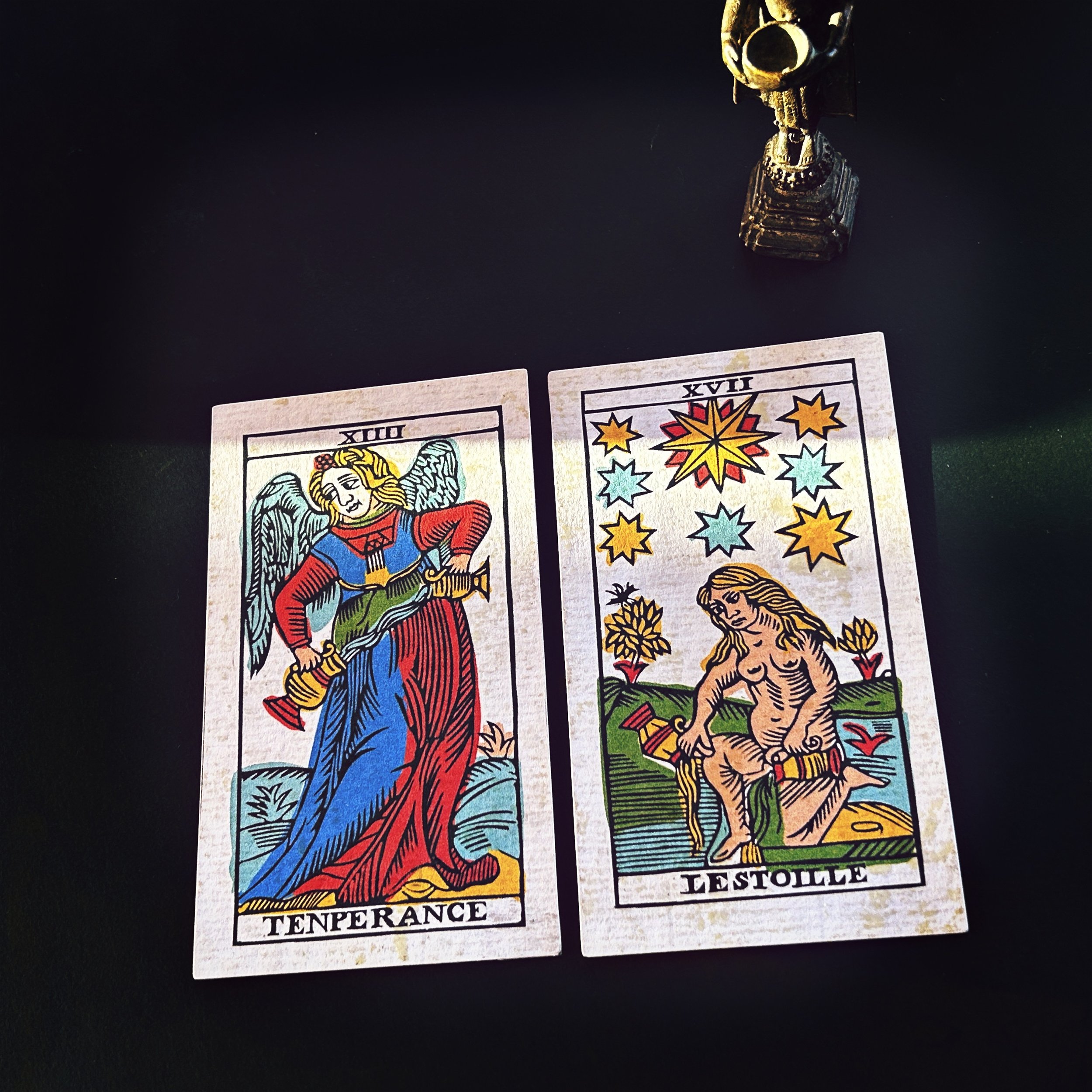
Yet, stubbornly I apply the mantra that I share with my students when it comes to recitations: ‘This means that.’ No, it doesn’t. It’s all about what you see, not about what you know.
And this is what I see: the two are not on the same page. One is holding water. The other one spills it. So the problem is one of incompatibility. The perceived lack of communication, in spite of excellent competence, leads to lack of cooperation. In the end, each of these ladies is wasting her time in relation to the other.
I’m enemies of what wastes my time. It’s the biggest challenge threatening my claim to being Zen. If only… But I’m working on it. What the conscious mind has a hard time perceiving, the visual images I’m working with put in my face. The cards simply inform me what this thing I’m looking at is all about, relating everything back to my question. Suddenly I feel busted, or rather, my blind spot ‘feels’ busted. And that’s the whole aim: to bust a blind spot, a preconceived idea, or a grand illusion. Pulverize it all to death, so we can relish seeing the obvious.
But back to these cards: an excellent boss with whom you’re incompatible is not good news. Such a relation leads to nothing, but trouble. That’s the message here. So we’re not with predicting the restoration of balance à la Temperance and the Star without motivating why exactly we think so. The other hearing this message can do her part. She can go home and reflect on what causes this incompatibility and then act accordingly. And that’s the whole point of cartomancy: to make the other think further, or beyond even the most mundane of questions.
*
At least that’s what I was thinking, when I shot this picture in the woods of Ashøje…